


30 Mar Microfluidic Study of Navigation Behavior of Hyperactivated Sperm
Understanding how sperm reach the egg is still one of the most fascinating problems in reproductive biology. Inside the female reproductive tract, sperm face a highly structured and fluid-rich environment filled with narrow passages, folds, and mucus-like fluids. While hyperactivation, a change in swimming behavior, is known to be essential for fertilization, its physical role in navigation has remained unclear. This microfluidic study explores how hyperactivated sperm behave in environments that mimic these conditions using microfluidic chips and controlled fluid properties.
To address this, the researchers focused on how sperm motion changes depending on the surrounding fluid and confinement. Rather than assuming hyperactivation simply makes sperm swim more vigorously, they examined whether it produces distinct movement strategies. Their findings show that hyperactivated sperm do not follow a single pattern. Instead, they adopt different swimming modes depending on whether the fluid behaves like a simple liquid or a mucus-like material.
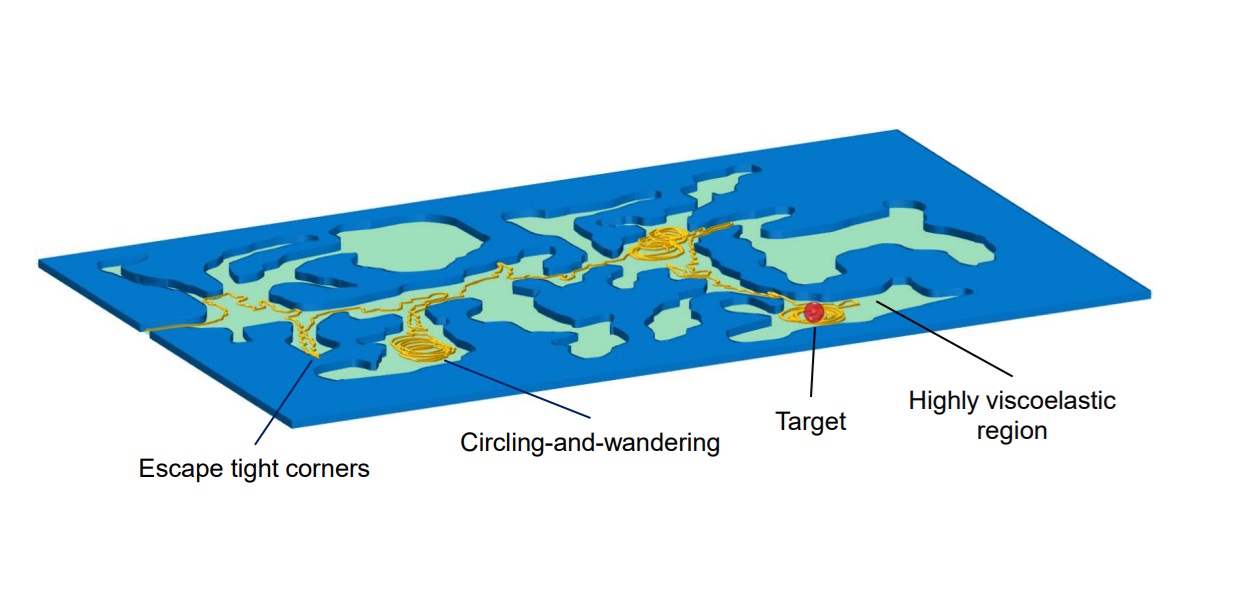
“Schematic of how circling-and-wandering swimming behaviormay facilitate sperm migration within the FRT.” Reproduced from Zaferani, M., Baouche, Y., Lago-Alvarez, Y. et al. Sperm hyperactivation drives a circling-and-wandering swimming behavior. Nat Commun (2026). under a Creative Commons Attribution 4.0 International License.
The experimental setup relied on microfabricated microfluidic devices that mimic the confined geometry of the reproductive tract. The microfluidic devices consisted of a straight inlet channel connected to shallow circular chambers, with some chambers containing internal pillars to represent structural obstacles. These features created a controlled environment where sperm motion near walls and around obstacles could be directly observed. The devices were fabricated using standard soft lithography, filled with fluid, and then seeded with sperm under low-flow conditions to allow natural swimming behavior.
To recreate different physiological conditions, the team used two types of fluids. A Newtonian buffer represented simpler fluid environments, while a polyacrylamide-based solution mimicked the viscoelastic properties of mucus. Hyperactivation was induced chemically, and sperm motion was tracked using microscopy and image analysis. This allowed the researchers to quantify how fast sperm moved, how persistently they traveled, and how their trajectories evolved over time.
The results reveal a striking difference in behavior between the two fluid environments. In the Newtonian medium, hyperactivated sperm exhibited wandering trajectories that allowed them to explore space efficiently. In contrast, in the mucus-like viscoelastic fluid, sperm often moved in tight circular paths, which limited how far they could spread. This difference had a clear impact on transport, with wandering motion leading to much greater spatial exploration than circling.
An especially interesting observation was the presence of a mixed swimming mode in the viscoelastic fluid. Some sperm alternated between circling and wandering, switching between localized motion and broader exploration. This hybrid behavior resulted in intermediate transport efficiency and suggests that sperm can balance staying within a region while still searching new areas.
Interactions with boundaries added another layer to the story. In the microfluidic chambers, sperm that exhibited wandering motion tended to scatter away from surfaces, while circling sperm were more likely to remain near walls or become trapped around obstacles such as pillars. These observations highlight how both fluid properties and geometry shape navigation strategies.
To connect these observations to more realistic environments, the researchers used simulations to model sperm movement in crowded, porous structures. The results showed that simple forward swimming becomes inefficient in complex geometries, where cells can easily get trapped. In contrast, the mixed circling-and-wandering behavior proved more robust, allowing sperm to navigate through confined and irregular spaces more effectively.
Overall, this work shows that hyperactivation is not just about increased activity. It enables sperm to adopt multiple navigation strategies that depend on their surroundings. By combining microfluidic experiments with fluid physics and modeling, the study provides a clearer picture of how sperm move through the complex environments they encounter on the path to fertilization.
Figures are reproduced from Zaferani, M., Baouche, Y., Lago-Alvarez, Y. et al. Sperm hyperactivation drives a circling-and-wandering swimming behavior. Nat Commun (2026). https://doi.org/10.1038/s41467-026-70143-6 under a Creative Commons Attribution 4.0 International License.
Read the original article: Sperm hyperactivation drives a circling-and-wandering swimming behavior
For more insights into the world of microfluidics and its burgeoning applications in biomedical research, stay tuned to our blog and explore the limitless possibilities that this technology unfolds. If you need high quality microfluidics chip for your experiments, do not hesitate to contact us.