


19 Apr Microfluidic Neural Probes for Drug Delivery, Stimulation, and Brain Recording
Understanding how the brain functions requires tools that can both stimulate and monitor neural activity while also interacting with its chemical environment. Traditional neural probes often specialize in only one or two of these capabilities, limiting their ability to provide a complete picture of neural circuit behavior. Integrating optical stimulation, electrical recording, and chemical delivery into a single platform remains a challenge, particularly without sacrificing device density or scalability. Yet, microfluidics has a solution!
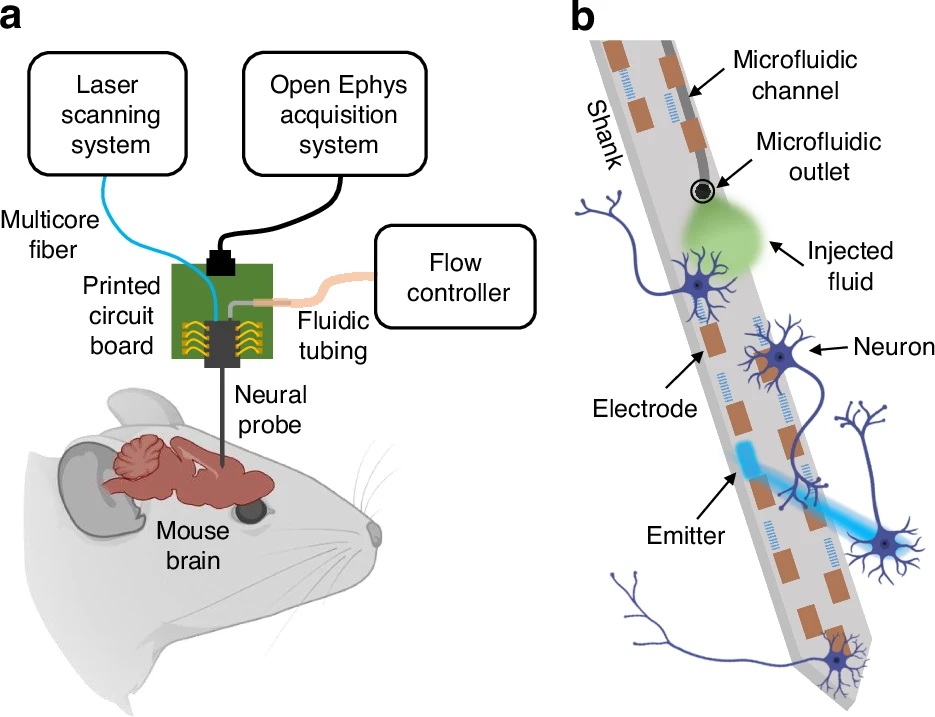
In this work, the authors present a nanophotonic neural probe that combines photostimulation, electrophysiological recording, and microfluidic delivery within a single microfluidic chip platform. Their approach integrates optical waveguides, microelectrodes, and a buried microfluidic channel within a microfluidic device architecture on one compact probe, enabling simultaneous light delivery, neural signal recording, and localized drug injection. Each probe includes 16 optical emitters, 18 electrodes, and one integrated microfluidic channel, allowing multimodal interaction with brain tissue in vivo
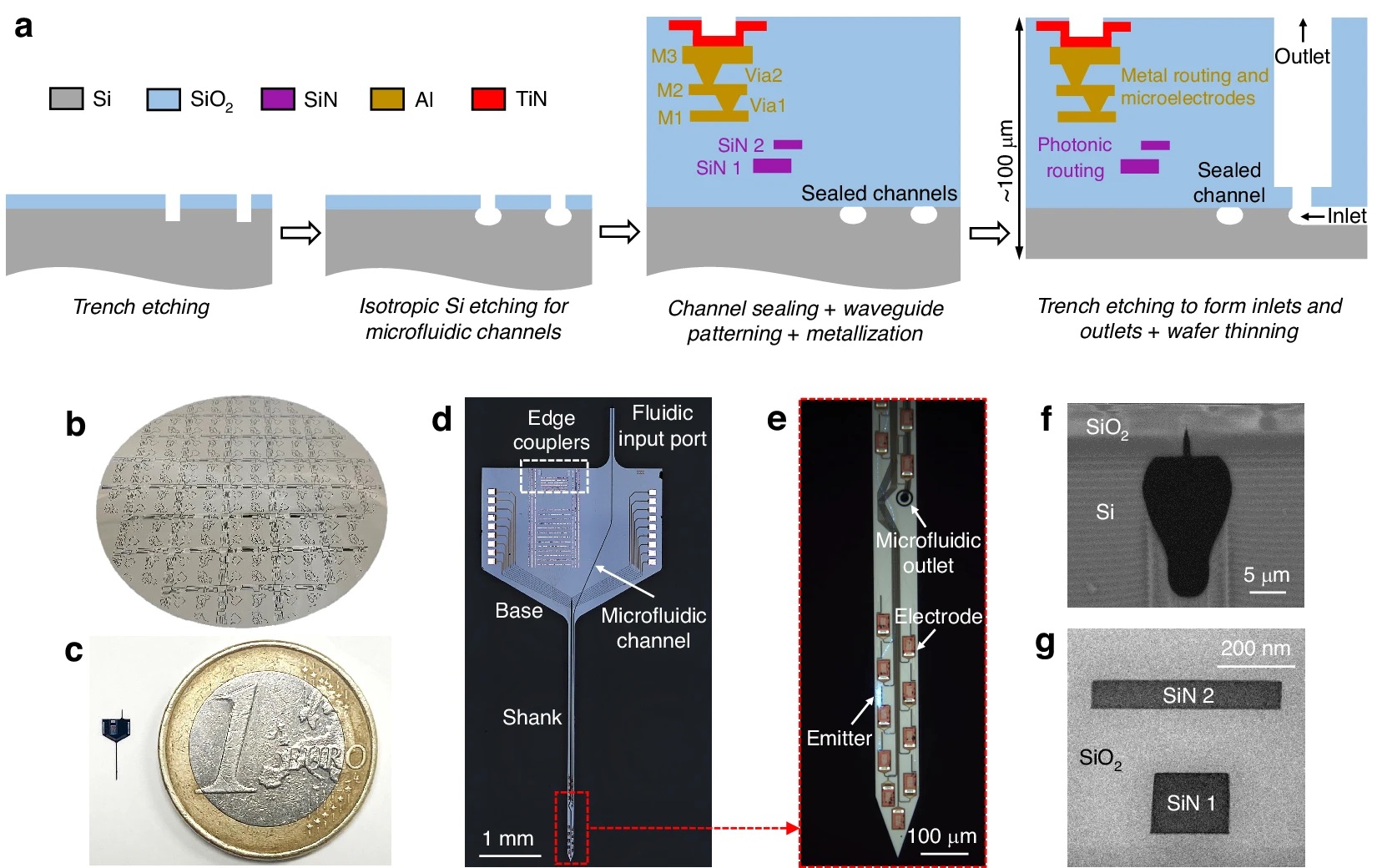
“a Cross-section schematics of the neural probe fabrication process (not to scale). b Photograph of a 200-mm diameter neural probe wafer; the background was removed for improved visibility. c Photograph of a neural probe next to a coin. d Optical micrograph of a neural probe chip prior to packaging. e Enlarged view of the neural probe shank with one grating coupler emitting light. f Cross-section scanning electron micrograph of the integrated microfluidic channel. g Cross-section transmission electron micrograph of the two SiN waveguide layers. d–g adapted from our conference abstract, ref. 84” Reproduced from Mu, X., Chameh, H.M., Movahed, M. et al. Nanophotonic neural probes for in vivo photostimulation, electrophysiology, and microfluidic delivery. Microsyst Nanoeng 12, 100 (2026). under a Creative Commons Attribution 4.0 International License.
The devices were microfabricated using a silicon photonics foundry process, representing a scalable microfabrication approach for producing complex microfluidic chips. Microfluidic channels were etched into the silicon substrate and sealed before adding photonic and electrical layers on top. Silicon nitride waveguides were used to route light to grating coupler emitters along the probe shank, while titanium nitride electrodes enabled neural recording. The microfluidic channel runs beneath these layers and terminates at an outlet positioned among the emitters and electrodes for localized chemical delivery. During operation, laser light is coupled into the probe via a multicore optical fiber, electrical signals are recorded through an acquisition system, and fluid is delivered through an external pressure-controlled setup
The authors validated each function of the probe in vivo using optogenetic mice. Optical stimulation successfully triggered neural activity with spatial selectivity, showing that nearby emitters produced stronger neuronal responses. Microfluidic injection was used to deliver 4-aminopyridine, a compound that induces seizure activity, demonstrating precise chemical modulation of neural circuits. The probes were then used in a fully integrated mode where seizures were first induced chemically and subsequently suppressed using optical stimulation, while electrophysiological recordings monitored the process in real time. In many cases, light delivery reduced seizure-related neural activity, highlighting the ability of the device to both perturb and control brain dynamics
Overall, this study demonstrates a scalable platform for multimodal neural interfacing, combining optical, electrical, and microfluidic functionalities within a single microfluidic device. This approach opens new possibilities for studying complex brain processes, especially in applications such as epilepsy research, where precise control and monitoring of neural activity are essential. The integration strategy also highlights how microfabrication and microfluidic chip design can expand the capabilities of implantable biomedical devices.
Figures are reproduced from Mu, X., Chameh, H.M., Movahed, M. et al. Nanophotonic neural probes for in vivo photostimulation, electrophysiology, and microfluidic delivery. Microsyst Nanoeng 12, 100 (2026). https://doi.org/10.1038/s41378-026-01192-6 under a Creative Commons Attribution 4.0 International License.
Read the original article: Nanophotonic neural probes for in vivo photostimulation, electrophysiology, and microfluidic delivery
For more insights into the world of microfluidics and its burgeoning applications in biomedical research, stay tuned to our blog and explore the limitless possibilities that this technology unfolds. If you need high quality microfluidics chip for your experiments, do not hesitate to contact us.