


19 Aug How Microfluidic Flow Shapes Root Growth in Medicago sativa
Plant roots continuously respond to the physical and chemical conditions around them, yet the effects of fluid flow on root development remain difficult to study quantitatively. Conventional soil and hydroponic experiments provide limited control over the mechanical forces experienced by individual roots, particularly at the scale of root hairs. To address this challenge, researchers developed a microfluidic platform that allowed them to expose Medicago sativa, commonly known as alfalfa, to precisely controlled flow conditions and examine how hydrodynamic forces influence root architecture.
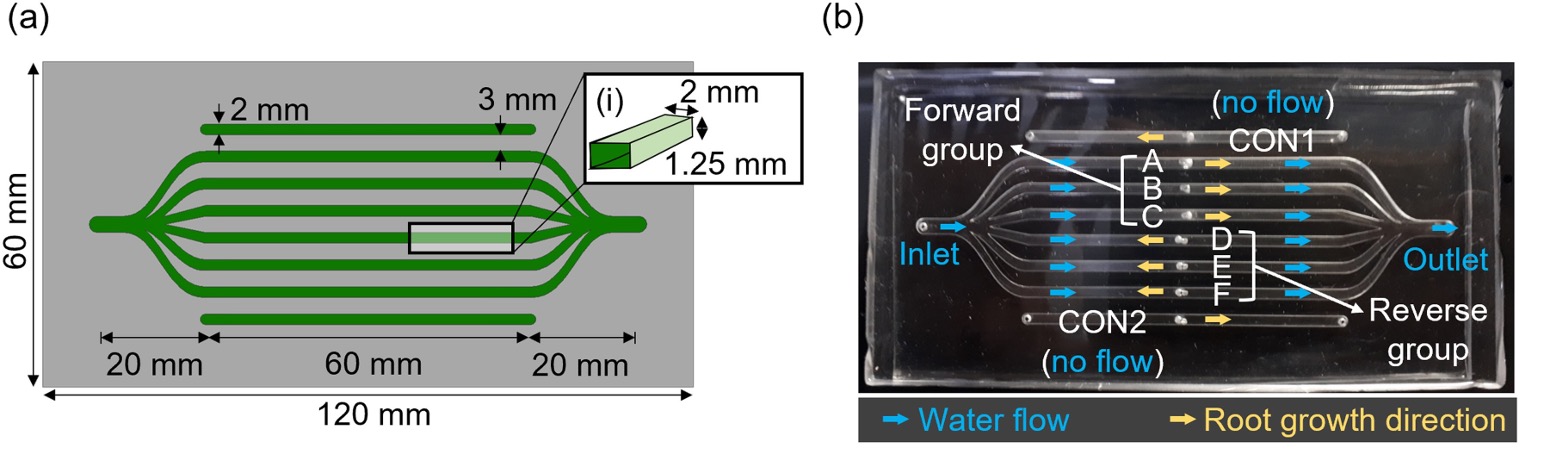
The researchers designed a plant-on-a-chip system containing six parallel growth channels connected to a common inlet and outlet, along with two independent control channels. Each channel was 2 mm wide and 1.25 mm high, providing enough space for the roots to grow while remaining accessible for microscopic observation. The microfluidic chip was designed so that roots could grow either with or against the direction of flow, allowing the team to determine whether flow direction itself affected development.
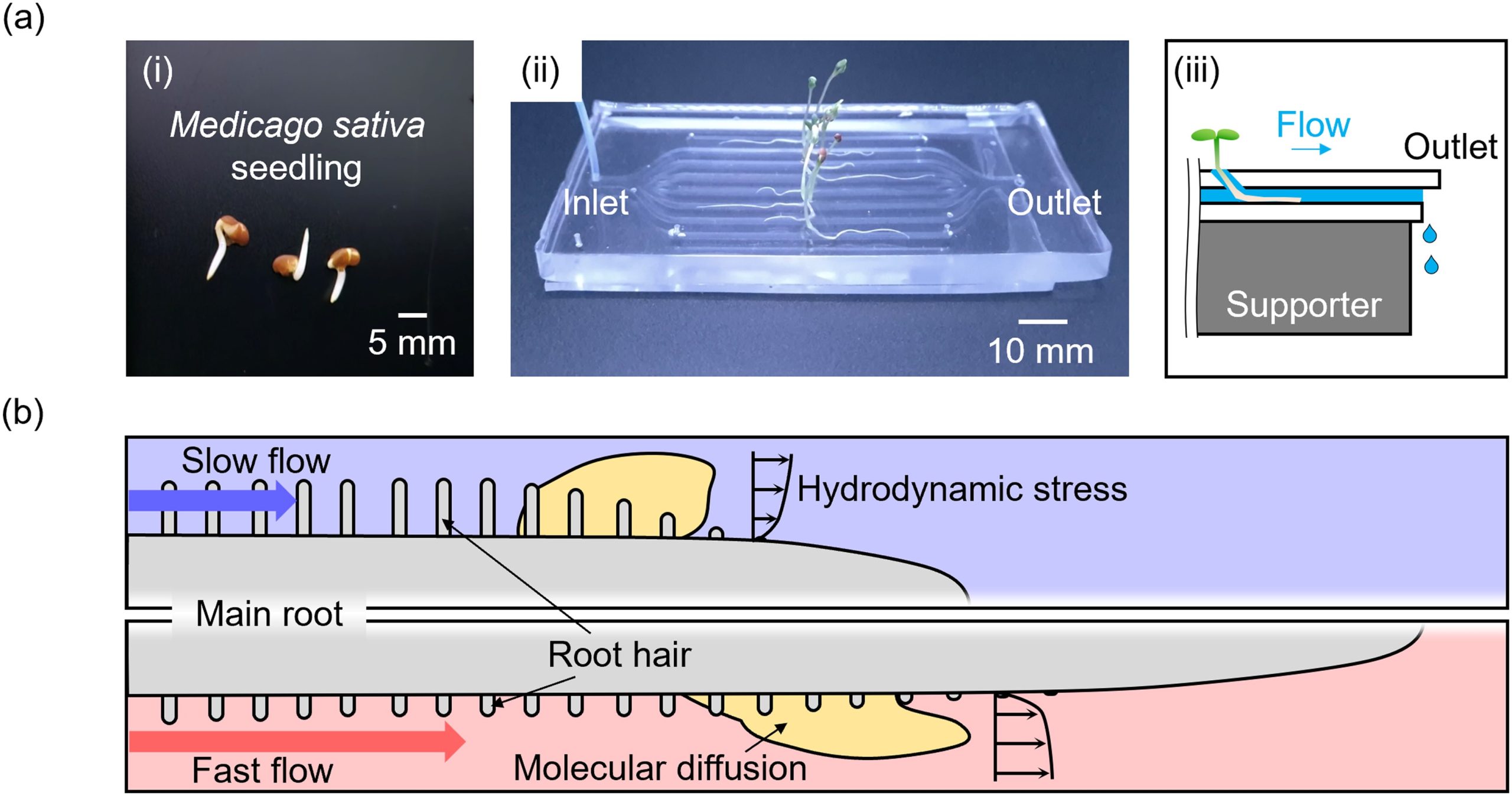
“Schematic of this study. (a) Simple flow of the experiment and illustration of plant chip. (i) M. sativa seeds germinated after being kept in the dark for 1 d. (ii) The image of seedlings after being transplanted and grown in the plant chip. Flow applied to the roots using a syringe pump for 48 h. Six channels are connected to a single set of inlet and outlet. Roots grow either in the same direction as the flow along the channel or in the opposite direction. Two independent channels are located outside the main channels, serving as control. (iii) Due to the leakage at the transplanting holes, the outlet is fabricated horizontally to the channel. (b) Illustration of the experimental results and target of CFD analysis. With various inlet flow rates, the main root and root hairs are quantitatively observed, and mechanical stresses exerted by flow and diffusion are analyzed using CFD.”. Reproduced from Doh-Won Yi, Jeongmok Kim, Joong Yull Park; Mechanoadaptive root growth in Medicago sativa under controlled microhydrodynamic environments. Lab Chip 2026; 26 (15): 4316–4330. with permission from The Royal Society of Chemistry.
For microfluidics fabrication, the team first produced an acrylic mold using CNC machining and then used a double-casting process to form the channel geometry. The final device was made from PDMS, selected for its transparency, biocompatibility, and gas permeability. The PDMS channel layer was plasma bonded to a flat PDMS substrate, and angled transplantation holes were added to guide newly germinated roots into the channels. The outlet was also positioned horizontally with the channels to reduce leakage through the seedling transplantation openings and maintain stable flow.
After germinating the seeds for one day, the researchers transplanted seedlings with approximately 5 mm roots into the microfluidic device. Water was delivered continuously for 48 hours using a syringe pump at inlet flow rates ranging from 0.1 to 100 μL/min, while control roots experienced no flow. After growth, the researchers measured primary root length, root width, and thousands of individual root hairs using microscopy and image analysis. They also performed computational fluid dynamics simulations to estimate wall shear stress, bending stress, and the transport of root-secreted compounds such as ethylene around the growing roots.
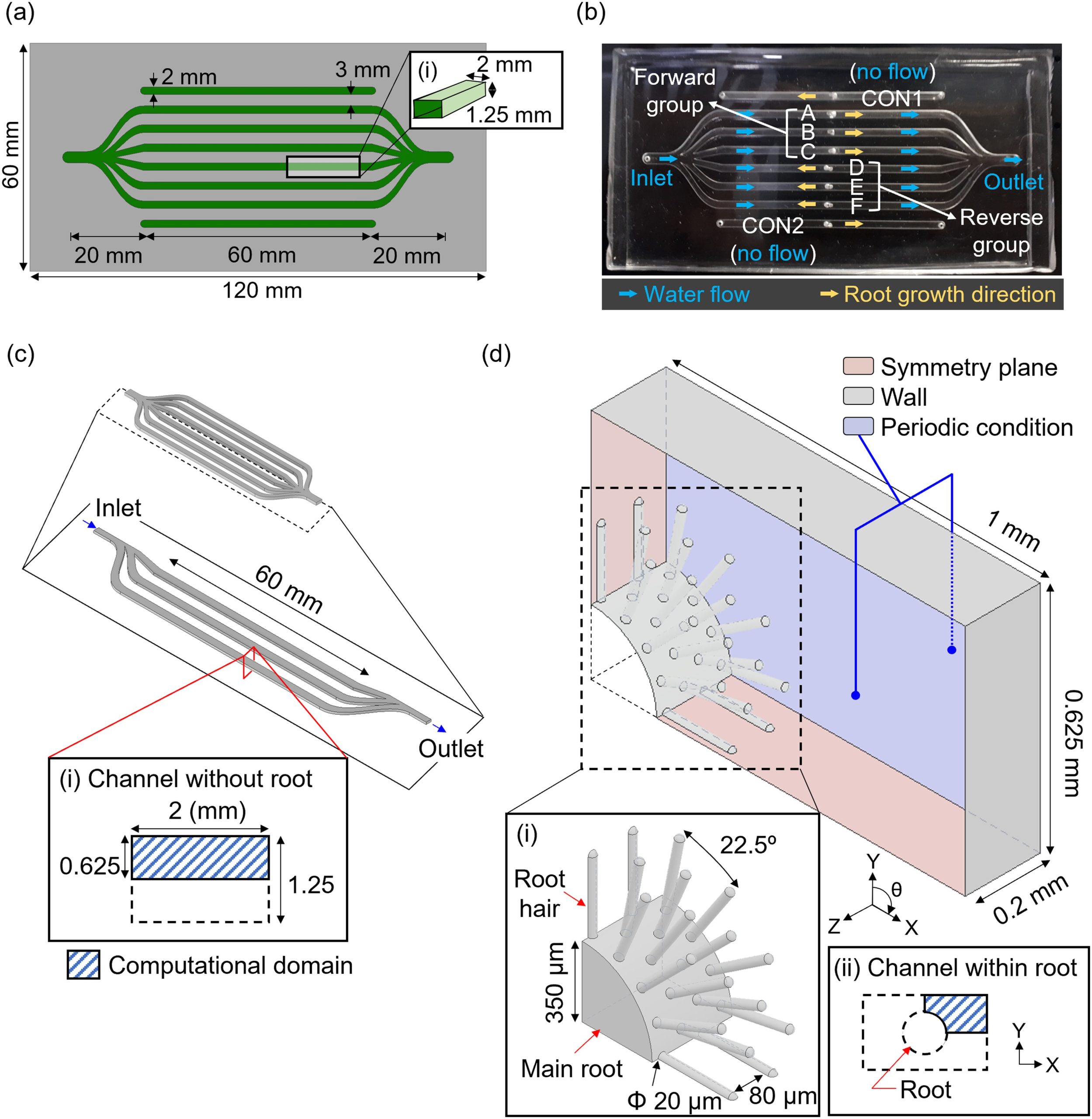
“Plant chips used for experiment and CFD analysis. (a) Dimensions of plant chip. All channels in the plant chip are 2 mm wide and 1.25 mm high. (b) Name of channels. Channels A, B, and C are the forward group where the main root grows in the same direction as the flow. Channels D, E, and F are the reverse group where the main root grows in the direction opposite to the flow. Transplanting holes are located at the center of the straight channel region. (c) Computational domain of an empty plant chip for CFD analysis. A quarter of the plant chip is used by applying symmetry conditions. (i) Cross-sectional view of the channel depicting the computational domain. (d) Quarter size of the channel with plant root computational domain for CFD analysis. Root part is assumed as a wall condition. Symmetry and periodic conditions are applied for the calculation efficiency. (i) Detailed root dimensions are provided. The diameters of the main root and root hairs are set to their mean values from experimental results. The root hair lengths are set to 185, 100, and 73 μm based on experimental results, and root hairs are arranged in a staggered pattern. (ii) Cross-sectional view of the channel depicting the computational domain indicated.” Reproduced from Doh-Won Yi, Jeongmok Kim, Joong Yull Park; Mechanoadaptive root growth in Medicago sativa under controlled microhydrodynamic environments. Lab Chip 2026; 26 (15): 4316–4330. with permission from The Royal Society of Chemistry.
The results showed a clear shift in how the roots allocated growth as flow increased. Higher flow rates generally produced longer primary roots while reducing both root width and root hair length. At 50 μL/min, the mean primary root length was about 60.7% greater than in the no-flow control, while at 100 μL/min, mean root hair length was approximately 65.7% lower. A particularly noticeable transition occurred between 0.1 and 1 μL/min, suggesting a threshold at which the roots began responding differently to their hydrodynamic environment. Root hair growth patterns also changed from a more sigmoid distribution under low-flow conditions toward an exponential pattern as flow increased.
The simulations helped explain these observations by showing that increasing flow exposed root hairs to greater shear and bending stresses while also increasing advective transport around the roots. Longer root hairs could partially shield the primary root by creating a low-velocity region near its surface, but the hairs themselves experienced greater mechanical loading. Together, the experimental and computational results suggest that once hydrodynamic stimulation exceeds a certain range, M. sativa shifts toward primary root elongation rather than extensive root hair development.
Overall, this microfluidic study demonstrates how plant-on-a-chip systems can provide controlled environments for studying root mechanobiology and quantifying plant responses that are difficult to isolate in conventional cultivation systems.
Figures are reproduced from Doh-Won Yi, Jeongmok Kim, Joong Yull Park; Mechanoadaptive root growth in Medicago sativa under controlled microhydrodynamic environments. Lab Chip 2026; 26 (15): 4316–4330. https://doi.org/10.1039/d5lc00827a with permission from The Royal Society of Chemistry.
Read the original article: Mechanoadaptive root growth in Medicago sativa under controlled microhydrodynamic environments
For more insights into the world of microfluidics and its burgeoning applications in biomedical research, stay tuned to our blog and explore the limitless possibilities that this technology unfolds. If you need high quality microfluidics chip for your experiments, do not hesitate to contact us.